

Strategy
A weekly decision log template for fitness creators in England
Use a weekly decision log in your fitness creators planning template for England: what each row holds, which evidence to cite and when to reopen approval.
A weekly decision log is the part of a fitness creator plan that changes while everything else holds still. Each review adds one row, so the original plan stays readable and every changed assumption carries a date. Do not fill blank fields with industry averages. Use observed evidence from the named audience and service.
What to take away
- Add one row after each review rather than rewriting the original plan.
- Every row names the evidence received, the assumption it touches, the owner decision and the next gate.
- Choose from continue, change, pause or stop, and date every changed assumption.
- Link each entry to a retained record and note who could not take part or which events were excluded.
- A change of audience, claim, payer or data purpose opens a new approval cycle.
What to settle before the first entry
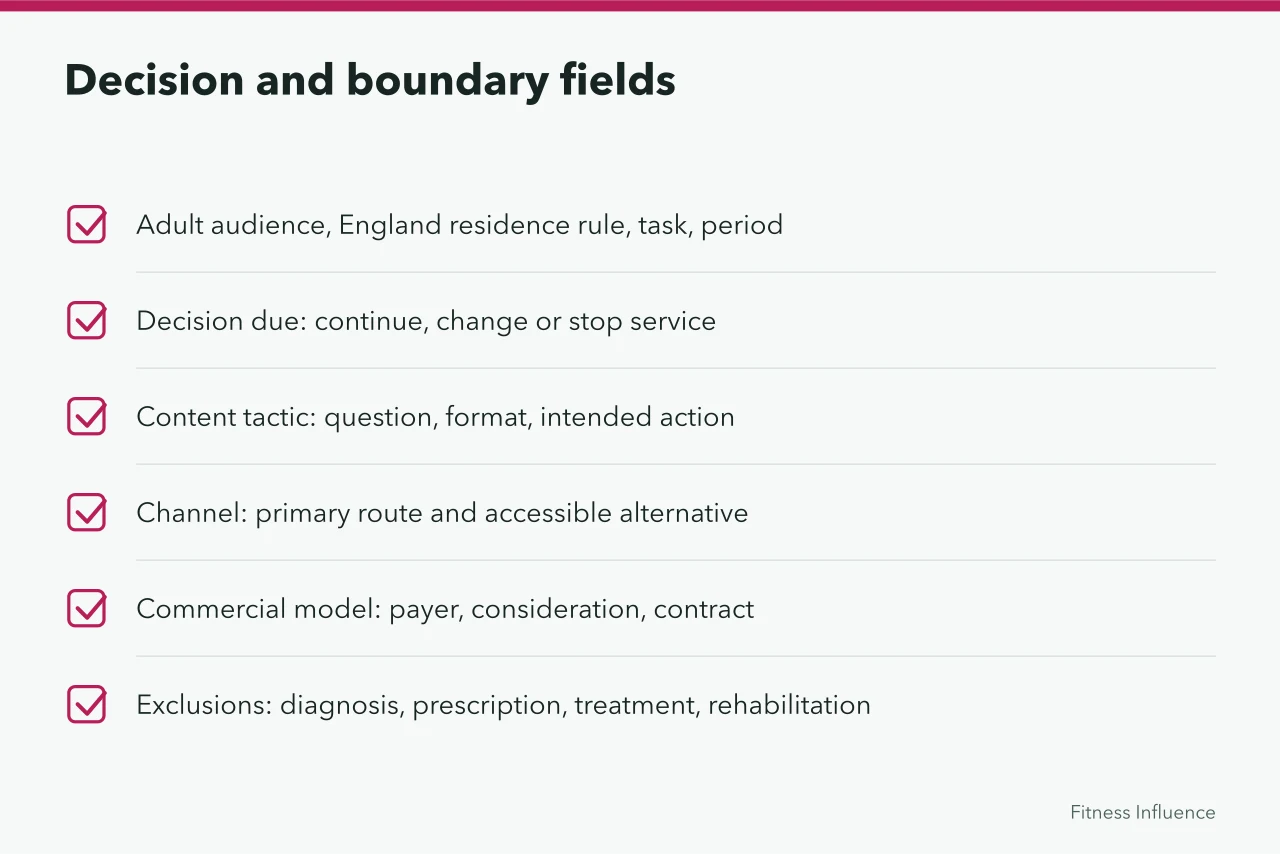
The log needs a fixed boundary to measure against, so complete the decision and boundary fields first. Enter the adult audience with its England residence rule, the decision due, the content tactic, the channel, the commercial model, the exclusions and the referral route before any row is written.
The NHS exercise hub separates public guidance by audience and activity. It is a source boundary, not permission to prescribe. Add the named professional role, for example a registered dietitian or a CIMSPA-registered trainer, so that a log entry about an out-of-scope question can point to a real person.
What each column holds
| Column | What goes in | Rule |
|---|---|---|
| Date | The day of the review | Date every changed assumption |
| Evidence received | A source, participant code or event file | Link it to a retained record |
| Assumption affected | The plan statement the evidence supports or weakens | Quote the plan's own wording |
| Owner decision | Continue, change, pause or stop | A named owner decides |
| Next gate | The review or gate that follows | Hold if a sign-off is blank |
A reviewer comment without the reviewed version cannot release an asset. If the log shows a comment but no version, the decision for that row is to pause, however good the comment sounds.
Three illustrative entries
Entries stay short and tie a decision to evidence. The rows below are illustrative only. The first is a day-30 example in which a plan tests whether Instagram reaches the named audience.
| Date | Evidence received | Assumption affected | Owner decision | Next gate |
|---|---|---|---|---|
| Example day 30 | Completion figure for the defined task and qualified enquiry count from the tracked route | Assumption that Instagram reaches the named audience | Continue with email as primary channel | Day 60 review |
| Example, review week | Reviewer comment on a draft, no version recorded | Draft is ready for release | Pause until the reviewed version is attached | Resubmit with version |
| Example, payer change | Sponsor withdraws and a new payer is proposed | Payer and claims unchanged | Change: open a new approval cycle | Repeat the affected reviews |
Link the entry to a retained record and note who could not take part or which events were excluded. Without that note, a later reader cannot tell whether a good figure came from the whole eligible group or from the people who were easiest to reach.
Evidence an entry can cite
Define the observation window and exclusions before collection, then draw the Evidence column from four measures:
- Task completion = eligible participants who completed the defined task / eligible participants who started.
- Source coverage = material factual claims with an approved source / all material factual claims reviewed.
- Correction rate = items receiving a substantive correction / reviewed items published in the period.
- Qualified enquiry rate = enquiries meeting the written buyer criteria / all non-test enquiries received through the tracked route.
Do not mix tests, staff checks, duplicate events or ineligible records into a denominator. The GOV.UK method for completion rate explicitly counts completed transactions over all starts, including failed or partial starts. This plan adapts that logic but claims no government-service status.
Closing an audience question
A channel counter without the eligibility rule cannot close an audience question. A raw count of views says nothing about whether the people reached were the named audience, so the log row should cite the completion or enquiry figure and the rule that made each person eligible.
Accessibility belongs in the same row. Government inclusive communication guidance was updated in June 2026 and covers accessible formats and channels. It was written for government communicators, so record it as method input rather than a certificate for a creator page.
Asset production gates
- Research brief: signed scope, frame defined
- Draft: cleared source ledger, version hash
- Health review: named sign-off, referral text
- Accessible master: captions, transcript, alt text
- Release: all reviews and disclosure logged
When a row reopens approval
If a decision changes the audience, claim, payer or data purpose, open a new approval cycle, not a minor edit. The earlier sign-offs were given for the old version, so they cannot carry across to the changed one.
The log should say which of the four triggers applied and which reviews are repeated. Add incident contacts for unsafe instruction, privacy breach, missing disclosure, copyright complaint and inaccessible content, so an incident row names a person rather than a department.
The weekly rhythm to day 90
Review the file weekly and date every changed assumption. A blank sign-off or reconstructed metric means hold, not success. The log is evidence for the final 90-day decision, which only works if the weekly rows were written at the time and not rebuilt afterwards.
At day 90, archive the inputs, outputs, denominators, exclusions, incidents and decision. Keep the log with them, because the sequence of rows shows why the plan ended as it did.
Before you act
- Complete the decision and boundary fields before the first row.
- Add one dated row after every review.
- Cite a retained record in each Evidence cell.
- Note who could not take part or which events were excluded.
- Open a new approval cycle if the audience, claim, payer or data purpose changes.
Common questions
How often should the log be reviewed?
Review the file weekly, add one row after each review and date every changed assumption.
Can a reviewer comment release an asset?
No. A reviewer comment without the reviewed version cannot release an asset.
What does a blank sign-off mean?
A blank sign-off or reconstructed metric means hold, not success.